

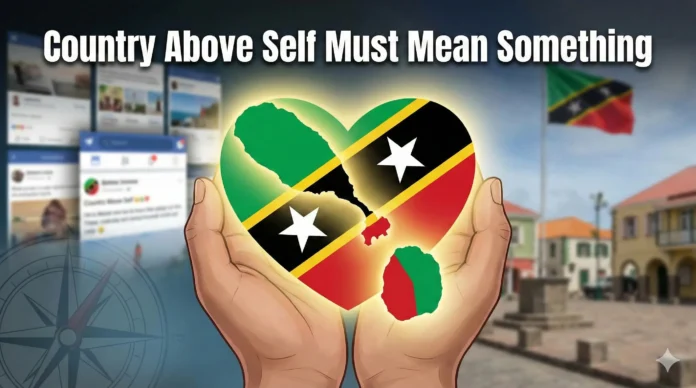

In every nation’s journey, there are moments when its people are tested-not by natural disasters or economic hardship among other areas but by how they choose to respond to disagreement, controversy and external scrutiny. At the heart of these moments lies a simple but powerful principle that has guided St. Kitts and Nevis for generations: ‘Country Above Self ’- our motto.
In today’s digital age, social media has become the fastest breeding ground for debate, emotion and often misinformation. While healthy discussion is a cornerstone of democracy, there is a growing tendency for discourse to spiral into outrage without reflection. The recent discussions surrounding the Memorandum of Understanding (MOU) signed between St. Kitts and Nevis and the United States-particularly the claims that CARICOM nationals may be accepted with the exclusion of Haitians-have ignited such reactions.
Some critics argue that the Prime Minister Drew- who is also the CARICOM Chairman- should not have referenced Haiti, suggesting that doing so sounded shunning. In response, Haitians, friends of Haitians, and others holding strong opposing views have taken to social media to express anger and frustration. Passion in defence of human dignity is understandable. However, what must give us pause is the manner in which some commentary has crossed the line from advocacy into outright condemnation of country-often without full context, clarity or responsibility.
To their credit, many nationals of St. Kitts and Nevis have pulled the brakes. They have chosen reflection over reaction, caution over chaos, and patriotism over performative outrage. They have reminded us that defending vulnerable communities does not require tearing down one’s own nation on the global stage. There is a difference between holding leaders accountable and actively joining voices that portray the country as bad or morally bankrupt without substantiated facts.
Country Above Self does not mean blind loyalty to any government or leader. It means recognising that our words-especially when broadcast internationally-carry weight. It means understanding that diplomacy, regional relations, and international agreements are complex, nuanced, and often still evolving. Reckless commentary, driven by emotion rather than facts, can damage national credibility and weaken our voice within CARICOM and beyond.
And to those who choose to engage in reckless response at the altar of party politics, it must be said plainly: Shame on you. When political allegiance becomes so blinding that it overrides national interest, dignity, and common sense, the damage extends far beyond any one administration or leader. Country Above Self cannot be selectively applied when it suits partisan convenience and abandoned when it does not. Weaponising sensitive regional issues to score political points cheapens our democracy and weakens our national standing.
Patriotism is not orange, red, yellow blue and green, government or opposition-it is responsibility, restraint and respect for the nation we all call home.
We must remember that patriotism and compassion are not mutually exclusive. One can advocate for fairness, inclusion, and regional unity while still standing firmly in defence of one’s country. True nation-building requires maturity-knowing when to speak, how to speak and when to listen.
At this critical juncture, let us recommit ourselves to the values that have sustained us. Let us debate, yes-but with facts. Let us disagree-but with respect. And above all, let us remember that ‘Country Above Self’ is not a slogan for convenience; it is a responsibility we owe to ourselves, to each other, and to generations yet to come.