

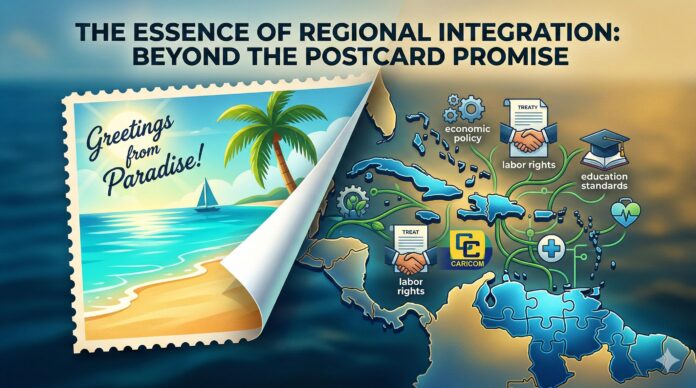

The Caribbean has long been marketed to the world as a paradise neatly packaged in “sun, sea and sand.”
Turquoise waters, golden beaches and rhythmic festivals form the postcard image of our region. Yet far beyond that aesthetic appeal lies something far more significant: a shared geographical space and a deeply intertwined history that should naturally foster a unified regional front.
But does it?
Regional integration has been a recurring aspiration for decades. Institutions have been formed, treaties signed and declarations made. CARICOM stands as the formal expression of our desire to act collectively. Yet, year after year, debates persist about how united we truly are- and whether our mindset as Caribbean people aligns with the lofty goals set by our leaders.
Take the issue of free movement within the region. Few topics spark as much divided opinion. On one side, there are those who see opportunity: expanded labour markets, cultural exchange, skills mobility, and strengthened economic resilience. On the other, there are fears- job displacement, strain on social services, wage competition and the unsettling question of national identity.
Both perspectives deserve examination. But what they also reveal is something deeper: as a people, many of us are still grappling with what regional integration actually requires of us. It is easy to unite around culture. We beam with pride when our athletes dominate international tracks and fields.
We celebrate each other’s music, from soca to reggae to dancehall. We travel across islands for Carnival, food festivals and fashion events without hesitation. In those moments, regional identity feels natural and effortless.Yet integration is not sustained by entertainment alone.
True regionalism demands difficult conversations about socio-economic policy, labour rights, border control, education equivalencies, healthcare access and economic disparities between territories. It requires an honest look at how policies in one country may impact another. It demands that we confront uncomfortable truths about inequality, protectionism and fear.
Too often, when controversial statements are made about CARICOM or regional arrangements, the immediate response is emotional- either quick agreement or sharp condemnation. Accusations fly that certain comments break away from the essence of CARICOM. But perhaps what we lack is not loyalty to the idea, but the maturity to interrogate it fully.

Are we prepared to assess the shortcomings of regional mechanisms without interpreting critique as betrayal? Can we acknowledge that integration is a work in progress-one requiring reform, refinement and accountability?
Another essential dimension lies with our elected leaders. Are they true regional integrationists? Or does national self-interest consistently trump the collective front when difficult decisions arise? It is understandable that leaders prioritize their constituents. That is their mandate. Yet regionalism requires a delicate balance between sovereignty and solidarity. Without political will at the highest levels, integration becomes rhetoric rather than reality.
At the same time, integration cannot rest solely on heads of government. It must live in the consciousness of the Caribbean people. It must be reflected in how we view one another- not as competitors for limited resources, but as partners in shared advancement.
The essence of regional integration is not about dissolving borders or erasing national pride. It is about recognizing that our futures are interconnected. Climate change does not respect island lines. Economic shocks ripple across territories. Migration patterns are shaped by shared vulnerabilities.
If we are to truly examine how together we are, we must move beyond symbolic unity and confront substantive policy questions with courage and clarity. We must be willing to refine the CARICOM force so that it functions not merely as a diplomatic framework, but as a practical engine for regional advancement.
The Caribbean is more than a destination. It is a collective destiny. And integration- imperfect, debated and evolving-remains one of our most powerful tools for shaping it.