

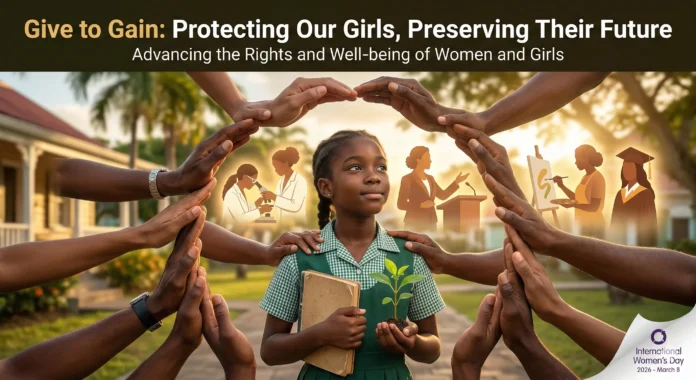

As the world prepares to observe International Women’s Day on March 8, the 2026 theme – “Give to Gain”- calls on societies to embrace generosity, collaboration and shared responsibility in advancing the rights and well-being of women and girls.
Traditionally, this occasion highlights the achievements of women in leadership, business, science, public service and community life. These accomplishments deserve recognition and celebration. Yet, alongside the progress that has been made, there are sobering realities that cannot be ignored.
Recent police reports detailing the separate nine-year imprisonment sentencing of two men; both charged with unlawful carnal knowledge with one of them at six (6) counts along with one (1) count of procuring drugs to perform a miscarriage have once again brought into sharp focus the vulnerabilities faced by young girls within our society. These cases serve as a stark reminder that while we celebrate the achievements of women, we must also confront the threats that undermine the safety and dignity of girls long before they reach adulthood.
If the theme “Give to Gain” is to have true meaning, then society must give something far more fundamental: protection, vigilance, and a collective commitment to safeguarding our young girls.
The safety of children has never been the responsibility of parents alone.
Caribbean societies have long embraced the concept that “it takes a village to raise a child.” That philosophy must extend beyond nurturing and education; it must include protection. Communities must become vigilant guardians against those who prey on vulnerability.
Too often, warning signs exist long before tragedies unfold. Too often, people suspect wrongdoing yet hesitate to intervene. In a small society where many know each other, silence can become complicity. When we fail to speak up, we fail the very children who depend on the adults around them to shield them from harm.
The painful memories of lives lost remind us why vigilance matters.
In June 2025, the Federation mourned the tragic death of 15-year-old Janelika Romney, who was kidnapped and stabbed to death, with an elderly man charged in connection with the crime. Her loss remains a wound in the national conscience -a reminder of how quickly innocence can be shattered.

The 2017 May/June missing person turned homicide case of 17-year-old Leanna Napoleon was also a dark troubling matter for our country as three males included her older brother with charged with the crime.
Of note, the start of this month of March marked eight years (1st March 2018) since, the nation was shaken by the horrific double murder of the Finch sisters -19-year-old Naomi and 20-year-old Jimmyliah of Keys Village. Their deaths remain etched in public memory as a symbol of how violence can abruptly extinguish young lives filled with promise.
And beyond the headlines are countless other girls and women whose stories are not always told publicly – victims of sexual abuse, exploitation and assault who must live with the trauma long after the news cycle has moved on.
These realities demand that we reflect deeply on what it truly means to celebrate women.
To “give to gain” must mean more than symbolic gestures or annual tributes. It must mean giving attention to the safety of girls in our homes, our communities, our schools and our workplaces. It must mean giving courage to speak when something seems wrong. It must mean giving support to victims who need compassion rather than silence.
When we protect our girls, we give them the opportunity to gain the full experience of life-to grow in safety, to enjoy the innocence of childhood, and to pursue their dreams without fear.
Every girl deserves the chance to become the woman she is capable of being. Every girl deserves a future defined by opportunity rather than trauma.
On this International Women’s Day, let the Federation recommit itself to the safety and dignity of women and girls. Let us strengthen the village mentality that once defined our communities- the understanding that every child matters, whether she is our daughter, our neighbour, our student, or simply a young life within our care.
Because when society gives protection, vigilance and compassion, we all gain a safer, stronger future.