By Spokesman Newsroom
BASSETERRE, St. Kitts (Thursday 7th March 2024) – “…St. Kitts and Nevis will not be throwing back its border at March 31st.” So said St. Kitts and Nevis Ambassador to CARICOM (Caribbean Community) Larry Vaughan when he called into ‘On The Edge’ programme-hosted Devonne Corneliusaired live on ZIZ radio on the morning of Thursday 7th March 2024, by way of wanting to “make some clarifications to the discussion to the issues raised…” “The first thing I’d like to ask our citizens to recognize is that Prime Minister [Dr.
Terrance] Drew is ably leading the discussion of St. Kitts and Nevis’ interests and our concerns, and they are based on the recommendations of the Intergovernmental Task Force that CARICOM has created to explore the matter.
It was only in Guyana that that Intergovernmental Task Force made recommendations and a decision has not yet been made on the recommendations. I want that first and foremost to be understood. The second thing that needs to be understood is that Antigua and Barbuda, Barbados and other member states would have made their determination known in the media and elsewhere on the recommendations made,” he stated.
Vaughan indicated that follow-ups were agreed to “that by the 7th of March, which is today, there will be a meeting of the legal affairs committee and the Intergovernmental Task Force and a final recommendation would be made following what was discussed in Guyana. So, that by the 15th [of March] we will have a meeting of the legal affairs committee and the heads will meet to further consider the draft amendments of the recommendations.” In highlighting five areas of recommendations, he shared: “There will be a transition period.
The transition period will be of three years for taking the necessary actions to implement free movement for all CARICOM nationals to live and work indefinitely. So when people are asking for time, there is a recommendation for time.
And it starts with a period that would be of three years in the first instance. So St. Kitts and Nevis will not be throwing back its border at March 31st. There is that transition period.” Vaughan added: “The second provision is that it would allow all – LOCAL NEWS – member states a transition period of up to seven years to put the necessary measures in place for the implementation of the minimum guarantees afforded to CARICOM
we are looking at it through the lens of our business community.” The CARICOM Ambassador went on to point out that “The third recommendation, that basic guarantees to be afforded to all CARICOM Nationals include to the rights on… work, to reside, to access primary and public secondary education and emergency health care. And also a guarantee of primary health care subject to agreements being reached on the definition of primary health care.” “So there’s still some work to be done to determine what will fall within the parameters of primary health care and then to determine what that will be and fifth, you have notification requirements for carve-out on provisions.
So, there will have to be a period where notification happens between the member states and then we can then move into it,” he added. According to him: “So March 31st is not carved in stone in that everything will just fall open by March 31st, but the desire, and here is what I want to stress on, the desire is for regional integration and for us to be as close as possible as a unit of people in this region.” Notably, Vaughan is also the Head of the Regional Integration and Diaspora Unit (RIDU) in the Federation.
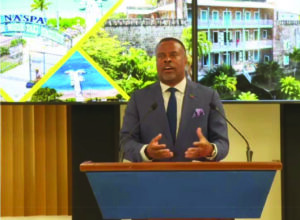
Front Banner Image: St. Kitts and Nevis Ambassador to CARICOM Larry Vaughan (Cropped photosourced Facebook/CARICOM: Caribbean Community)