BASSETERRE, St. Kitts (Thursday, 5th November 2026)-Workers are being urged to take a more active role in strengthening their trade unions.
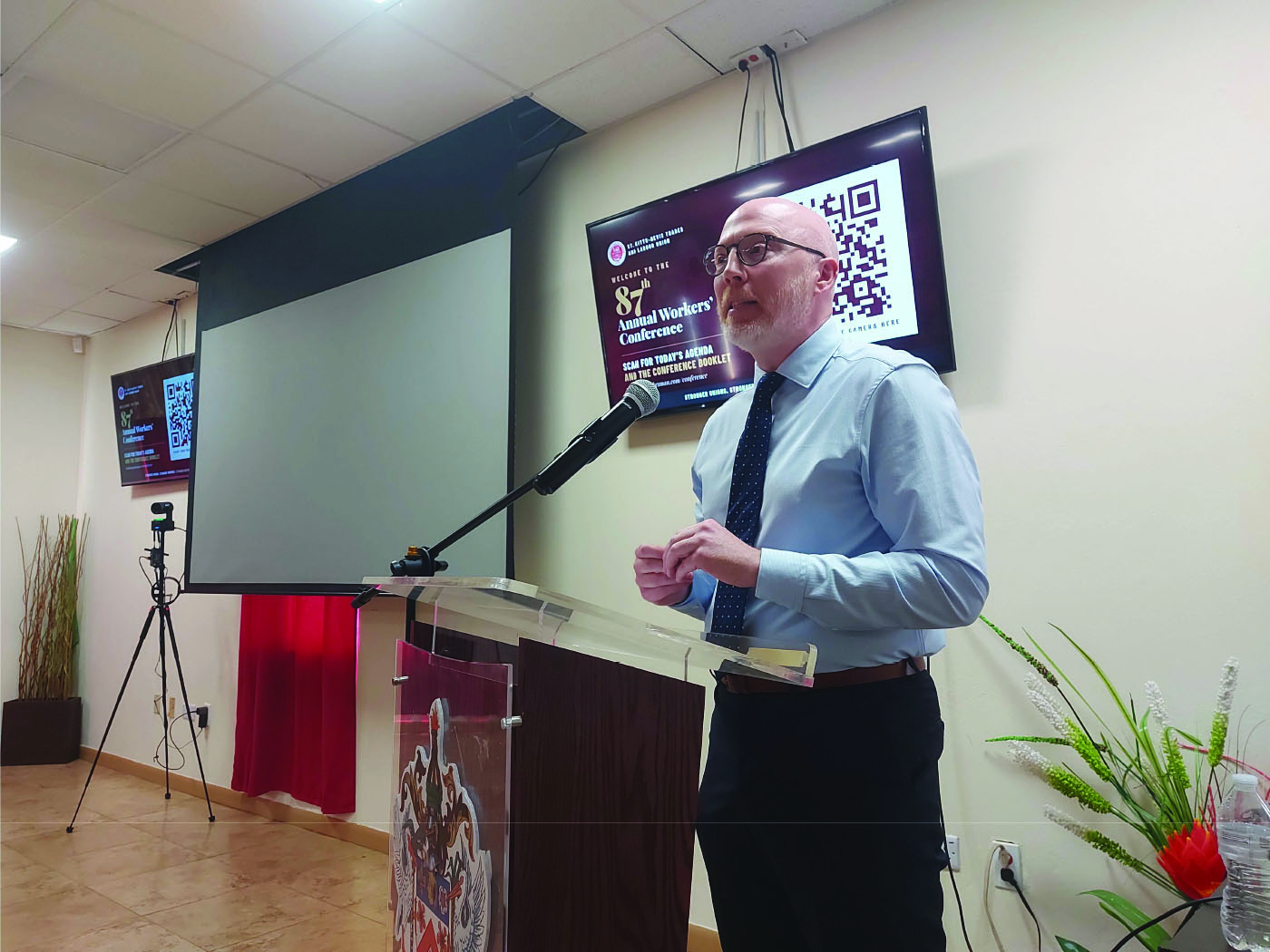
That call was made by Associate Professor and Chair of the Department of Labour Studies at Brock University in Canada Dr.Simon Black while delivering the guest address at the St. Kitts-Nevis Trades and Labour Union’s (SKNT&LU) 87th Annual Workers’ Conference, held on Sunday, 25th October 2026.
The Conference took place at the Solid Waste Management Corporation (SWMC) Conference Room, Taylor’s Range, Basseterre, under the theme ‘Stronger Unions, Stronger Workers: United in Partnership for Progress.’
Addressing the challenges facing labour movements and the need to rebuild trade union strength, Dr. Black emphasised the importance of organising workers.
“Well, like all good trade unionists know, we must organise. All workers need a union,” he stated.
“We need unions as a counterweight to the power of employers not only in the workplace but in politics and society more broadly.”
He also identified the hotel and hospitality sector in the Caribbean as an important area for strengthening trade union organising.
“And we especially must build union power in strategically relevant sectors such as the hotel and hospitality sector in the Caribbean,” he said.
Dr. Black stressed that workers must also participate in the daily activities of their unions rather than viewing them simply as organisations to approach when difficulties arise at work.
“The union is not simply a service provider that resides in Masses House to be called upon when we have difficulty in the workplace. The union is you,” he remarked.
He continued: “It is nothing less than an expression of your collective power as workers.”
According to Dr. Black, trade unions cannot function successfully without the active involvement of their members.
“It cannot be successful. It cannot be powerful without your participation,” he stated.
Turning to the challenges of recruiting and mobilising workers, Dr. Black acknowledged that organising efforts have faced difficulties in Canada, the United States and much of Western Europe.
“Organising, however, is easier said than done,” he observed.
He noted that although social media and other digital technologies can assist unions in reaching members and recruiting workers, traditional organising methods continue to have relevance.
“Social media and other digital technologies can no doubt be used to some effect to reach our own members and to recruit new workers to our unions,” he said.
To illustrate his point, Dr. Black referred to the organising campaign at an Amazon warehouse in New York City, where workers successfully established union representation.
He explained that when reporters questioned the young organisers about the digital platforms they had used, the workers instead pointed to a publication from 1936 by William Z. Foster titled Organizing Methods in the Steel Industry.
Dr. Black outlined several of the methods discussed in that publication, including identifying workers who command the respect and trust of their colleagues, involving them in organising committees and encouraging rank-and-file participation.
He placed particular emphasis on direct communication between workers.
“And perhaps most importantly, one-on-one in-person conversations,” he stated.
He explained that such conversations allow organisers to listen to workers’ concerns, encourage change and prepare colleagues to respond to opposition to unionisation.
Dr. Black also drew attention to the history of trade union organising in the Caribbean, questioning whether similar methods had not been used to establish labour movements throughout the region during the 1930s and 1940s.
He referenced the organising work associated with Richard Hart in Jamaica, Elma Francois in Trinidad and Tobago, and J.A. Nathan in St. Kitts.
Reflecting on the lessons of earlier labour movements, Dr. Black suggested that present-day trade unions could benefit from revisiting traditional approaches to organising.
“I think that many of the answers to our question of how to rebuild our labour movements in 2026 can be found in the organising practices of the 1930s and 40s,” he stated.
He also spoke about concerns relating to declining solidarity among working people, individualism and changing attitudes towards collective action.
However, rather than dwelling on those concerns, he encouraged trade unionists to consider the organising experiences of previous generations.
“Or we can roll up our sleeves, learn the lessons of our ancestors, and organise, organise, organise,” Dr. Black declared in concluding his presentation.