By Spokesman Newsroom
BASSETERRE, St. Kitts (Wednesday 18th January 2022) – Minister of Public Infrastructure and Utilities Konris Maynard has pointed to using water from the ocean surrounding St. Kitts as an option to help the water supply situation.
He made the disclosure during his presentation at the Prime Minister press conference held on Wednesday 18th January 2023, at the NEMA Headquarters at Lime Kiln Commercial Development in Basseterre, informing that a proposal-which includes renewable energyis before the Cabinet has gotten approval in principle for a desalination of water project.“As long as all of the things check out with the due diligence and everything that is associated with doing a project checks out, we have given approval in principle for that.” According to the Utilities Minister “ …we have now reached the point where we need a renewable source of water. Now where can we find a renewable source of water on a small island like St.
Kitts? Where is water? Is there any water at all? Is it close by? Is it in a hill somewhere? It’s right out there in the sea. We can’t done the sea at least not in this lifetime or lifetimes to come and because of climate change with our ice caps melting, sea levels are actually rising so we need to use that water and so what this government has realised is that the time has come for us to invest in the desalination of water.” He continued: “That is what is going to provide for us a buffer at least in the Basseterre region for us to augment the supply of water while we still do our drilling.” As understood, the company Beade is expected to begin well drilling in the Cayon and also in Basseterre(in the Shadwell area) in seeking to get 500,000 gallons from each well.
Maynard spoke about the water sources on the island. “75% of our water comes from groundwater which is water that percolates through the soil and resides in our reservoirs, our aquifers. 30% is surface water which is rain falls in the mountains, it runs down and we capture it from some seven small rivers or so that we have. We have about 7.5 million gallons worth of storage.
Presently, however, St. Kitts is only able to produce 5.6 million of water per day. However, we need about seven million gallons to have 24 hour 7 supply…” The Public Infrastructure Minister continued: “What that means is that we cannot provide 24 hour 7 water.
In the Basseterre region, you need about 4 million gallons of water. The Basseterre aquifer can give us about two million. Many years ago, it was determined that the safe yield from the Basseterre aquifer should be about 2.5 million gallons a day . with the reduced rainfall.
Rainfall has decreased by almost 20% in the last 10 years which is what is recharging our aquifers. We can assume that our safe yield from the Basseterre aquifer has also decreased to about 2 million gallons per day but I will report that we have been over extracting our aquifer in the last couple of years.” He went on further to explain: “What does that mean?
In every aquifer you have fresh water and usually below that you have salt water; there is barrier between the twosalt water and fresh water barrier. The experts are saying that we’re right on the border of that salt water and fresh water line.
We have to stop pumping at the rate we are pumping out of our aquifers.” Maynard noted that many persons have asked and that – LOCAL NEWS – 3he has heard the question over and over that – we had this big downpouring of rain…and a lot of water was seen in the streets running off to the sea, why don’t we capture that water and store it to help our water issue?” He responded to such a query saying: “It is a great question. Firstly, when it rains, about 80% of the water that falls, we lose it either through evaporation or through the trees and leavesthe vegetation that uses that water.
About 18% of that water goes towards our aquifers. Only about 2% runs off to the sea.” He highlighted that there is a water source problem. “What we do not have is a storage problem. What A negotiating round of the Taiwan-U.S.
Initiative on 21stCentury Trade concluded Jan. 17 in Taipei City, with both sides pledging to continue expanding the already robust economic and trade ties. Staged in-person under the auspices of the Taipei Economic and Cultural Representative Office in the U.S. and American Institute in Taiwan, the event was convened by Yang Jen-ni, deputy trade representative of the Cabinet-level Office of Trade Negotiations, and Assistant U.S.
Trade Representative Terry McCartin. According to the OTN, the U.S. delegation comprised officials from more than 20 agencies, including the Departments of State, the Treasury, Commerce and Agriculture, and underscored the importance Washington attaches to trade relations with Taiwan.
During the four-day round, both sides exchanged views on proposed texts covering anti-corruption, good regulatory practices, services domestic regulation, small and medium enterprises, and trade facilitation. They also reached consensus in several areas and agreed to maintain an ambitious negotiating schedule in the months ahead.
The OTN expects discussions to lead to more expedited customs clearance and verification procedures, higher transparency and multiple cooperation platforms allowing the two sides to address trade and investment hurdles more efficiently. Launched June 1, 2022, the trade initiative covers key areas such as the digital economy, trade facilitation, enhanced regulatory practices, environmental and climate action, promotion of standards, and the handling of nonmarket policies and practices. (SFC-E)we do have is a source problem.
In countries like Dominica or the United States or big countries where you have rivers where you can go and visit that are continuously running or there’s rain or snow melting in some area causing those rivers to flow all the time;that is a renewable source of water , and so you can use those to fill storage. We do not have that.
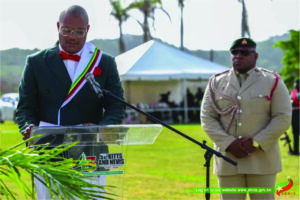
Our biggest reservoir is our aquifer so even if you say build seven million gallons of storage, it cannot compete with the storage we already have in our aquifer that would hold billions of gallons of water.” Meanwhile, …stated that it is important to note that only 60% of the aquifer have been explored.“We will continue as a government to explore the other 40% which resides outside of the Basseterre region.” Front Page Image: (Left) A photo of a desalination plant brine discharge pipe used for illustration purposes only – sourced from Fineartamerica.com by photostock-israel. (Right) Minister of Public Infrastructure and Ultilities. Konris Maynard while speaking during the Prime Minister press conference held on Wednesday 18th January 2023 (Spokesman Screenshot via Facebook/ZIZBrodcasting Corporation)