

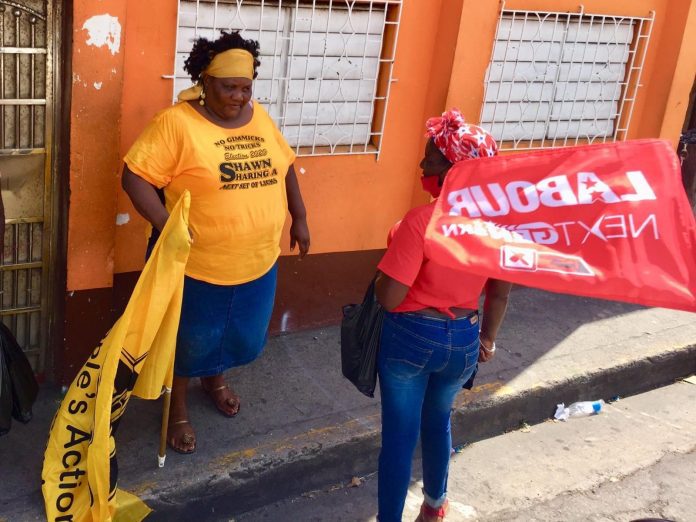

BASSETERRE, St.Kitts (Friday 26th June 2020) – The local observation team- who monitored the 2020 general elections in St.Kitts-Nevis has noted the long instances of ballot paper counting, spanning more than twenty- four hours (24) in one particular constituency, with suggestions given on the way forward for improvements in that area among others as polling day has been judged to be a fair one overall.
At a press conference held on Wednesday 24th June 2020, that NGO (Non-Governmental Organization) Coalition which comprises of The Christian Councils and Evangelical Associations of St.Kitts and Nevis supported by the St.Kitts-Nevis Chamber of Industry and Commerce, commented on its prepared executive summary final report during the session conducted at the chamber’s office located at Fortlands in Basseterre.
Copies of said report were presented to the members of the local media.
Chairman of the St. Kitts Christian Council P. Allister Rawlins, in his presentation, pointed to the counting of the ballots as of the challenges that observers experienced.
“Following the closing of the polls, the counting of the ballots and declaration for the results took an inordinately long time particularly in two constituencies-St. Christopher One and Eight; Especially in eight where the results were not known for over twenty-four hours.”
In the findings, as presented on the topic of ‘The Count’ in the report, the four (4) areas have been listed:
- In some instances there was no form signed to acknowledge agreement of results of the count.
- After the count in some constituencies there was no public signing of the results.
- The ballot papers for each candidate were not always placed into separate envelopes, sealed and signed by the returning officer and candidates’ agents as stipulated in the electoral law. In some instances, ballot papers were dumped together into the respective boxes at the end of each count.
- The counting process was generally inefficient in the sense that it took a very long time; in two instances more than twenty-four (24) hours to be completed and the results declared.
Included in the recommendations pertaining to the count are:
- Electoral reform is urgently needed to make the counting less time consuming, more efficient and effective.
- This could be greatly enhanced/achieved by ensuring that there be a preliminary count of the ballots at the polling stations where they are cast (this is currently done throughout the OECS and within CARICOM).
- Explore greater utilization for the vote and the count.
As it relates to the conduct of the 2020 General Elections, a representative the Evangelical Association and Christian Council in Nevis, Mario Phillip, outlined that: “The polling day activities for the June 5th 2020 federal elections in St.Kitts and Nevis as observed and reported on by our Observer Mission to our reckoning by and large met the commitments and standards which have come to be expected and associated with democratic elections for the process to be described as free and fear and free from fear.”
He continued: “The patience, discipline and commitment displayed by the populace as they stood in queues for hours or moved around searching to ensure that they exercise their franchise demonstrated that the people of the Federation are deeply committed to casting their votes within the context of the democratic process. As a result of the forgoing, the entire voting process took place within an atmosphere of peace ad non-violence.”

Phillip said the team observed administrative and organizational deficiencies.
“It is our view, based on what we observed on polling day during the casting of ballots and at the count of the same after the close of polls on that day that such deficiencies did not affect the general outcome of the elections; still the said deficiencies may have discouraged some voters.”
As part of the team’s conclusion of its report, it is expressed that “despite a number of administrative and organizational setbacks and inconsistencies the polling day activities form the opening of the poll, voting throughout the, the counting of the ballots and declaration of the June 5th 2002 federal elections in St.Kitts-Nevis indicate that the said elections were administered by the Electoral Office and the other stakeholders in a manner where they were free and fair and free from fear. The Mission’s assessment of the day’s activities is that the voters were able to cast their ballots without intimidation or harassment and that the results of the Elections reflect that the people freely voted for the candidate of their choice on Election Day.”