


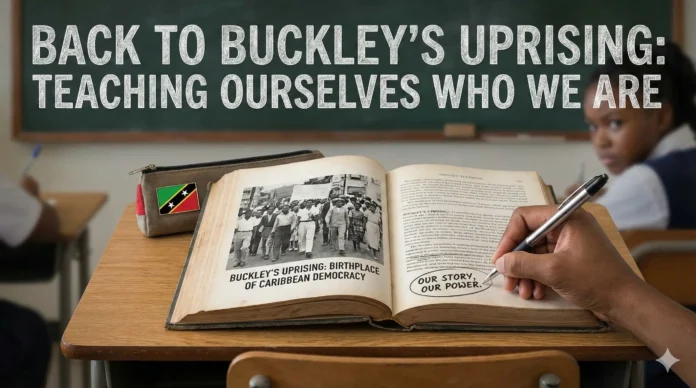

As national conversation recently turned to the Buckley’s Uprising and the government’s intention to mandate its teaching across all schools as part of the history curriculum, it is worth pausing-not just to applaud the initiative once again but to reflect on its deeper meaning and long-term promise.
Education has always been one of the most powerful tools for empowerment. A people who understand their history are far less likely to be confused about their identity, manipulated in their thinking, or uncertain about their future. When we teach our children who they are, where they come from and the struggles that shaped their present, we are not merely imparting facts-we are cultivating consciousness.
The Buckley’s Uprising is not just a historical event to be memorised for an examination. It is a living lesson in courage, resistance, sacrifice and collective action. It tells the story of ordinary working people who, faced with injustice and hardship, dared to challenge an oppressive system and demand dignity. That lesson alone carries immense value in shaping young minds to understand that progress has never been handed to us-it has been fought for.
Mandating the teaching of Buckley’s in our schools is therefore not about dwelling in the past. It is about anchoring our future. Such would allow students to see themselves reflected in history-not as passive observers of foreign narratives but as active contributors to their own story. In that sense, learning our local history becomes an essential part of Black history education. It affirms that Black resistance, resilience and intellect did not only happen elsewhere; it happened here, on this soil, among people who looked like us and lived where we live.
One can only imagine the impact if, over time, our history curriculum holistically captured the full essence of who we are as a Black people-our struggles and triumphs, our labour movements, cultural expressions, political awakening and community values. Such an approach would nurture a healthy and normal sense of pride, not rooted in arrogance but in understanding. Pride that shapes how we think, how we act and how we relate to one another as individuals, as a society, and as a nation.
When young people are grounded in their own story, they develop a clearer moral compass. They begin to see citizenship not merely as a legal status, but as a responsibility. They understand that nation-building is not abstract-it is personal. In that light, the national motto, “Country Above Self,” ceases to be a slogan recited on ceremonial occasions and becomes a lived principle, informed by historical context and collective memory.
The move to embed Buckley’s Uprising into the education system is therefore a step in the right direction but it should also be the beginning of a broader vision. A vision where education is intentionally used to empower, to heal historical amnesia and to strengthen national identity because a people who know themselves deeply are far better equipped to chart their course boldly.
If we truly want to build a confident, conscious and cohesive society, then teaching our children their own history is not optional-it is essential.