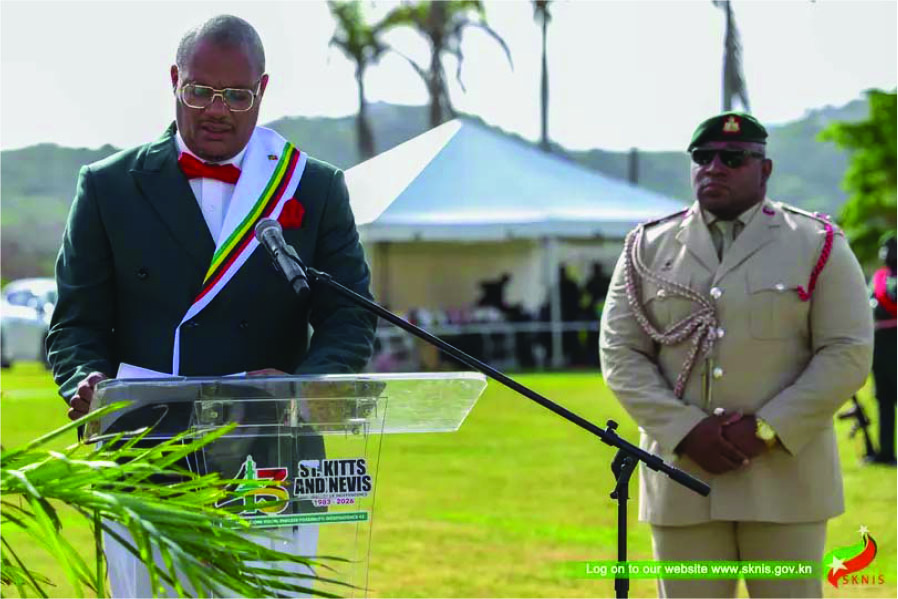
BASSETERRE, St.Kitts (Thursday 17th September 2026)-Acting Prime Minister Dr. Geoffrey Hanley is questioning what history will say about the present generation, as he called on citizens to continue the work begun by the national heroes.
“Our national heroes did their part. Now the question is: What will history say of ours?”
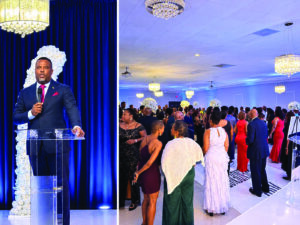
Such sentiments were expressed while he delivered the commemorative address on Wednesday 16th September 2026, during the National Heroes Day observance at the National Heroes Park in Conaree Village, St. Kitts.
Speaking on behalf of Prime Minister Dr. Terrance Drew (who is currently overseas on medical leave), Dr. Hanley said the statues of the five national heroes at the Park stood as “enduring witnesses to our national journey.”
He highlighted the contributions of Sir Robert Llewellyn Bradshaw, Sir Caleb Azariah Paul Southwell, Sir Joseph N. France, Sir Simeon Daniel and Sir Kennedy Alphonse Simmonds, noting that each had, in his own way, enlarged the possibilities of the people of St. Kitts and Nevis.
“Different men, different eras, different political journeys. Yet history gathered them here because each, in their own way, enlarged the possibilities of our people,” Dr. Hanley remarked.
He said the history of St. Kitts and Nevis extended beyond Independence on September 19, 1983, pointing to the contributions of men and women who worked in the cane fields, endured enslavement, demanded dignity, opened minds, cared for communities, produced food, built businesses, served the public and raised families.
He said independence was not intended to mark the end of the country’s national struggle.
“We sound it to remind ourselves that independence was never intended to be the conclusion of our national struggle. Independence gave us the authority to determine our own destiny. Every generation since has carried the responsibility to give that independence greater meaning,” Dr. Hanley said.
It was in this context that he posed the central question of his address.
“Our national heroes did their part. Now the question is: What will history say of ours?”
He then asked whether the present generation would protect the gains achieved by those who came before, expand opportunity, strengthen institutions, care for citizens and prepare children for a changing world. Will it say that when the responsibility came to us, we protected the gains that others sacrificed to achieve?” Dr. Hanley asked.
“Will it say that we expanded opportunity, strengthened our institutions, cared for our people, and prepared our children for a world vastly different from the one we inherited?”
He also questioned whether the generation would be remembered for choosing “togetherness over division, service over self-interest, and national progress over short-term convenience.”
“These are not abstract questions. They are the tests of leadership and citizenship in every generation,” Dr. Hanley said.
Addressing those who serve in public office, he said the monuments at the National Heroes Park should serve as standards against which leadership is measured.
“Leadership must always be about people,” he said. “It must be about leaving the country stronger than we found it. Widening opportunity, protecting the vulnerable and making decisions today that future generations will thank us for tomorrow.”
Dr. Hanley stressed that the responsibility for the country’s continued development did not rest solely with government.
“That responsibility belongs not only to government but to all of us,” he said.
He also pointed to the courage of the people as a key part of the country’s journey, saying that courage had carried the Federation “from chains to liberty, from colonial rule to self-government, from statehood to independence, and from one generation of nation-builders to the next.”
Hanley urged citizens to honour the national heroes through more than ceremonies and words.
“May we honour our national heroes not only with ceremonies and words but by continuing the work they began. May we be faithful stewards of their legacy,” he said.
In looking ahead to the generation that would one day assess the work of the present one, Dr. Hanley commented: “And when another generation stands here and looks back upon us, may they be able to say we too enlarged the possibilities of St. Kitts and Nevis.”