By: Precious Mills
BASSETERRE, St. Kitts (Friday
1st March 2019)-Participants and facilitators
of a recently held two-day Environmental Sustainability and Conservation
Leadership Training, held at Ross University School of Veterinary Medicine in
the West Farm community, have been applauding the foundational interactive
brainstorming and hands-on training exercise aspects of the first in a series
of planned activities.
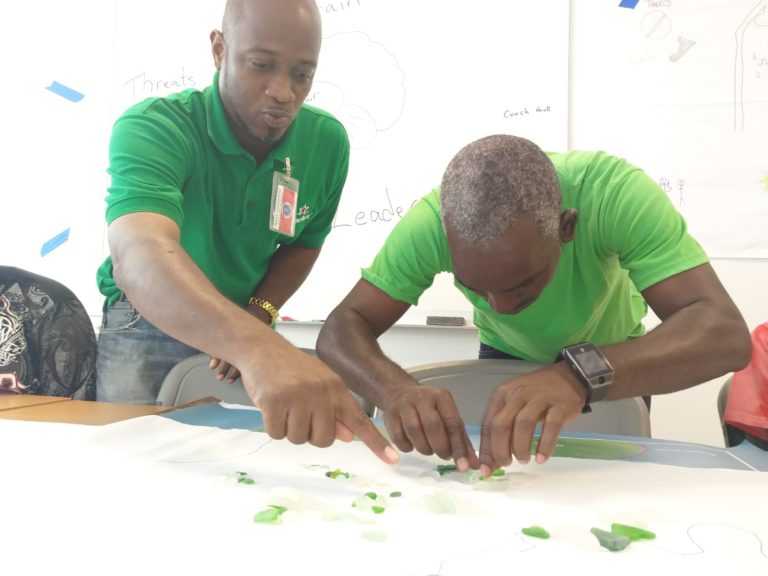
For that back to back session,
conducted on Saturday 23rd and Sunday 24th February at the school’s
Medicine Research & Pathology Building, topics explored included The Art of
Decision Making, Strategic Approaches To Inspire Action and Building
Your Own Harm Reduction Team.
Funding was made possible
through a grant received from the US Fish and Wildlife Service in collaboration
with the USAID (United States Agency for International Development).
As understood, a participatory
approach has been chosen to bring persons from various sectors together to
draft a comprehensive conservation plan which is aimed at reducing impact on
the Narrows Marine Managed Area by engaging people, businesses and communities.
Notably, the Narrows describes the channel which separates the islands of St.
Kitts and Nevis which can be identified in the area of Booby Island.
Participating institutions are
Ross University, Smithsonian Conservation Biology Institute, Canadian Wildlife
Health Corporation, Caribbean Youth Environment Network/Ripple Institution,
Department of Environment, Department of Marine Resources, Department of
Agriculture, Department of Youth Empowerment, Department of Tourism and the
Clarence Fitzroy Bryant College.
Lead facilitator was Luis
Cruz, a Ross University professor and Researcher of Human Behaviour in positive ways concerning
conservation and environmental sustainability assisted by Craig Stephen, Head
of the Canadian Wildlife Cooperative and a professor of population health.
Here is what some of the
participants had to say following the workshop:
Shaquana Jeffers
“The workshop for me was a
success and I’m proud to have been here. As a student at the Clarence Fitzroy
Bryant College who studies Environmental Science, it was a learning experience
for me as it covered some of the things that we need to know based on our
syllabus. Also, seeing that I am a person who loves the environment and I’m
also a big animal lover, it taught me how to be a leader or future
leader in conserving these
stuff so
that our generation or my children or my children’s children can enjoy these
things so it as a pleasure being here.”
Locksley Edwards
“As a Marine Conservation
Officer coming to the workshop, I was looking to see how it would help to
motivate myself and my peers as most of what the workshop addressed is what we
do on a day to day basis on our jobs so seeing the same information was more of
an encouragement and motivation to show that even though sometimes we may think
that 90 per cent out of a 100 it [a plan] won’t work, at least we know there’s
a 10 per cent that it will work. Overall, therefore, this workshop came as a
driving force to motivate me in knowing to push for that 10 per cent and that
percentage could increase…so if we could tap into the resources- which the
workshop is offering as a tutorial tools and knowledge- and we put this
into an actual plan, the idea is to see if this plan will work, and so it would
be an overall benefit that the workshop is progressive or positive and that the
leadership skills that we will learn will come out of each one of us
and benefit the environment, the community, jobs and us as individuals…”
“It’s not going to be easy but
it’s worth it” was a saying by Locksley which resonated with participants and
facilitators at the end of the workshop.
Mati Hanish (Ross University
student)
“For me, it’s really neat to
see people from all over St. Kitts, different parts of the government and
different careers all come together to start working towards one common goal,
the way that everyone found something; a way they could contribute because
people really started to adopt the idea that as individuals, they might not be
able to save the world but as a group, they can really make a huge difference
in St. Kitts and future generations.
Victoria Cahill
“For me being a new student
here at Ross [University] and on the island, it was really interesting to
see where everybody comes from, their take on the community, everybody’s
different perspective, different parts of the government that they come from,
how it works and how they think that they can come together to make their
one common goal work. As Locksley said, one quote of the weekend was: ‘It’s not
going to be easy but it’s worth it’, and everyone has something different that
they can contribute to their one common goal and they’re all pretty motivated
to make it work and it’s super exciting.”
According to Professor Cruz, “the workshop was about how can we empower people to believe that they are leaders because that’s what this project is basing on; we all have powers to lead and that doesn’t mean we have to be loud or yell or move mountains, we can all influence others in our own ways, it could very small or it could be on large scales. So, we are using the science of behavior change; this is things that psychologists use, sociologists use and in environmental conservation [and] biology, and even though we are not any of that, we are veterinarians and we work on health, and health is not just the absence of disease, it’s about social factors, environmental factors and biological [factors]. It goes from how do we exercise, how much sleep we have, what decisions we do that affect our health so this project is how do we better understand human behaviour and how can we find positive ways to influence based on theory and knowledge that many people have been working on.”
He continued: “It is also about using a concept which is called Harm Reduction which in simple terms [identifies] is there is a problem?, [and if] there is a very big problem and acknowledge that we are not going to get rid of it right away but there are little things that we can start doing with the conditions that we have now and even though there are many people who may think differently, we need all those different state of minds to come up with one vision, one main goal that we share; something that we value and then we are going to increment steps, little goals that are going to be build up into the major goal so that at the end I think it went extremely well.”
Professor Cruz commended the
participants for having taken the time out to attend the workshop. He said
overall it was good whilst noting that the “participation and engagement was
very high” on day two.
“I think we planted the seed
that ‘yes we can be leaders and yes it is possible’ and as Locksley said ‘It’s not
going to be easy but it’s worth it’, and if we have that mindset just by
achieving this [then] that seed, that idea in our brains that it is possible
that ‘I can get others onboard’ because other people might be thinking the same
thing but it takes someone to show them that it is possible and the more of us
showing that by example the more we are going to get and the better results,”
he told.
Professor Stephens was also
pleased.
“I was really happy to
see different people coming together to not only learn about how to become more
effective conservation leaders but actually come with a plan going forward to
work together. That was an exciting outcome of the day. I’m also really excited
to help Ross University work with the community and the citizens of St. Kitts
to collaboratively help the… resources of the island,” he commented.
A roundtable discussion is the
next scheduled session slated for Wednesday 6th March followed by a
conservation tools and stakeholder engagement on Saturday 23rd March.
A catamaran tour of the
Narrows with stakeholders is expected to take place in April, a communications
workshop in May with outreach efforts in June, July, August and September.