ANTALYA, Türkiye (Thursday 12th November 2026)- “Science is not telling us to surrender. It’s telling us to fight harder.”
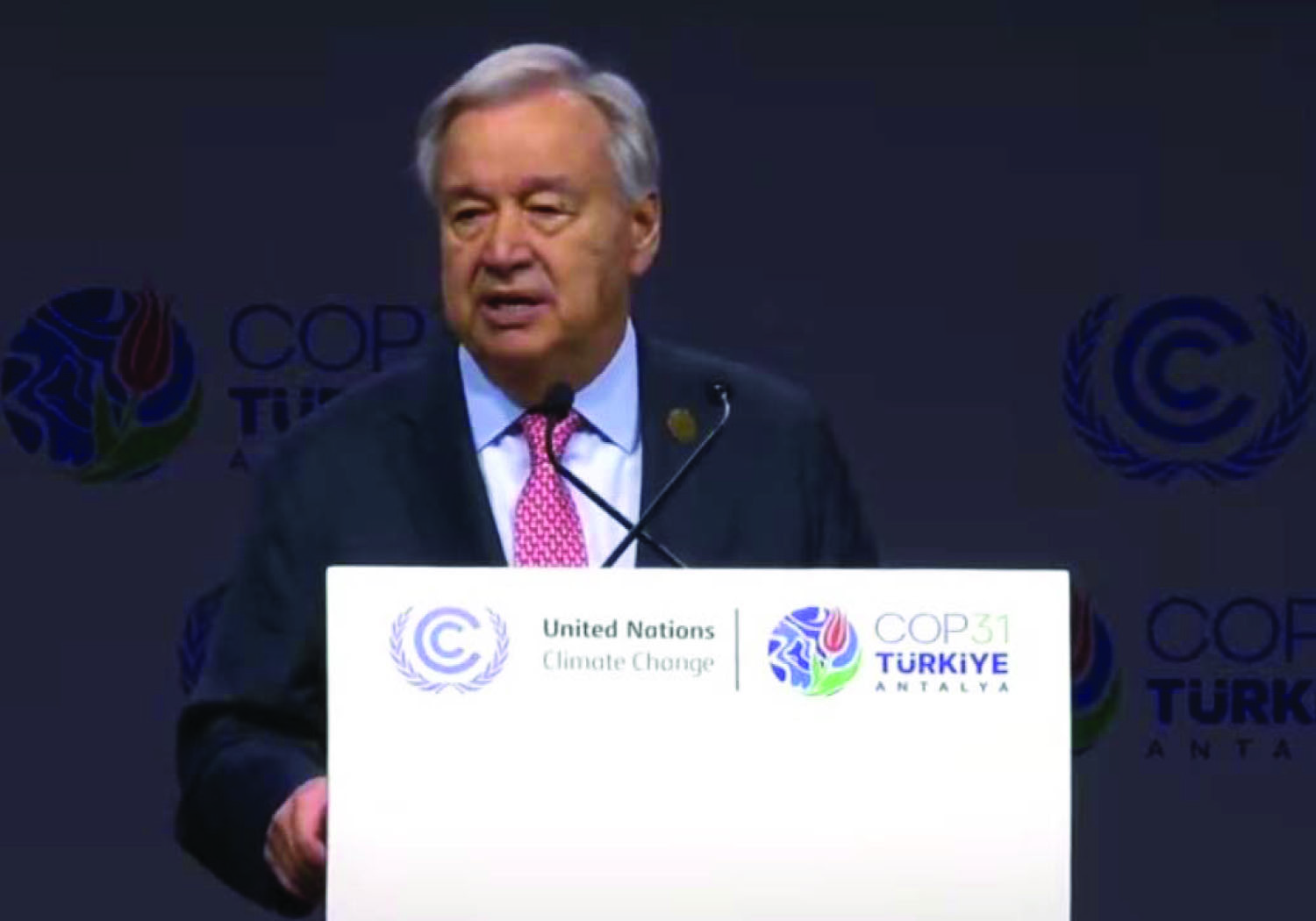
That was the message delivered by United Nations Secretary-General António Guterres as he addressed world leaders at the COP31 Leaders’ Summit in Antalya, Türkiye, on Wednesday 11th November, warning that the climate crisis is advancing faster than global efforts to contain it.
“Our first climate duty is to tell the truth,” Guterres declared.
“The brutal truth is that the climate crisis is outrunning us.”
His remarks came eleven years after the historic Paris Agreement, under which countries committed to efforts to limit global temperature increases to 1.5 degrees Celsius above pre-industrial levels.
Reflecting on the progress made and the challenges that remain, Guterres acknowledged that the world is now facing the prospect of exceeding that critical temperature threshold.
“Science tells us an overshoot above that level is now inevitable,” he said.
However, the UN chief insisted that exceeding the target must not become an excuse for abandoning climate action.
“The truth is that we have the power to determine how high, how long and how devastating that overshoot will be.”
“We have the power to make sure the overshoot is a temporary breach, not a permanent sentence.”
Guterres pointed to record global emissions in 2025, rising temperatures and increasingly destructive climate disasters as evidence of the urgency confronting governments.
“Heat records keep shattering. The last four years were the hottest ever,” he stated.
“Climate disasters are pounding lives, livelihoods and economies across the globe.”
Despite these developments, he highlighted significant progress in renewable energy over the past decade.
According to Guterres, solar energy accounted for just one per cent of global electricity generation ten years ago, but last year supplied nearly three-quarters of the growth in global electricity demand.
He also noted the rapid expansion of electric vehicles, with nearly one in three cars sold this year expected to be electric, compared with one in every hundred a decade ago.
“Exponential change is possible,” he declared.
Nevertheless, Guterres warned that the continued dependence on fossil fuels remains a major obstacle to achieving international climate goals.
“Fossil fuels must go the way of the dinosaurs,” he said.
“But that won’t happen on its own.”
“The dinosaurs did not have a lobby. But fossil fuels do.”
He accused fossil fuel interests of attempting to delay action through the distortion of scientific information and opposition to climate policies.
Turning to the pace of global action, the Secretary-General warned that current national commitments remain insufficient.
“Global emissions must fall around 6 per cent every year,” he stated, adding that existing national plans, including conditional commitments, would deliver at best one-third of the required reductions.
He further warned that even full implementation of those plans would leave the world facing temperature increases above 2.5 degrees Celsius by the end of the century.
“Our planet is heating up. The clock is winding down. It’s make or bake time.”
A major focus of his address was the unequal burden of climate change, particularly for developing countries and vulnerable communities.
“Climate justice is the defining challenge of the next decade,” Guterres declared.
“We cannot demand that countries transform their economies while denying them the means to do so.”
He called for a new Climate Justice Compact, emphasising the need for developed countries to reduce emissions faster while delivering promised financial and technological assistance.
Among his proposals were increased adaptation financing, stronger early warning systems and greater financial support for countries suffering climate-related losses and damage.
Guterres also drew attention to the financial disparity between fossil fuel profits and resources available to vulnerable nations.
“In the last quarter alone, the nine largest oil companies pocketed $95 billion in profits,” he stated.
“Meanwhile, the Loss and Damage Fund has received around $600 million.”
He noted that the latter amount was equivalent to approximately 14 hours of profits for those companies.
“Polluters must pay,” he declared.
The Secretary-General also stressed the importance of protecting workers and communities as countries move away from fossil fuels, calling for credible national transition plans that take their livelihoods into consideration.
He urged governments to move beyond negotiations towards practical implementation.
“Negotiations matter-but success must be measured on the ground,” he said.
“Implementation is essential.”
In concluding his address, Guterres recognised young people, scientists, Indigenous Peoples, civil society and Small Island Developing States for their continued efforts to demand stronger climate action.
“You are the conscience of this struggle,” he told them.
Looking ahead to his departure from the United Nations leadership next year, he pledged to remain involved in the global fight against climate change.
“I will not stop telling the truth. And I will not stop fighting for it.”
His final appeal returned to the central message of his address emphasising that despite missed targets, rising emissions and continuing challenges, the struggle for a sustainable future must continue.
“Together, let’s keep telling the truth about the climate crisis.”
“Let’s keep demanding the action that truth requires, and let’s keep fighting for the sustainable future we know is in our hands.”