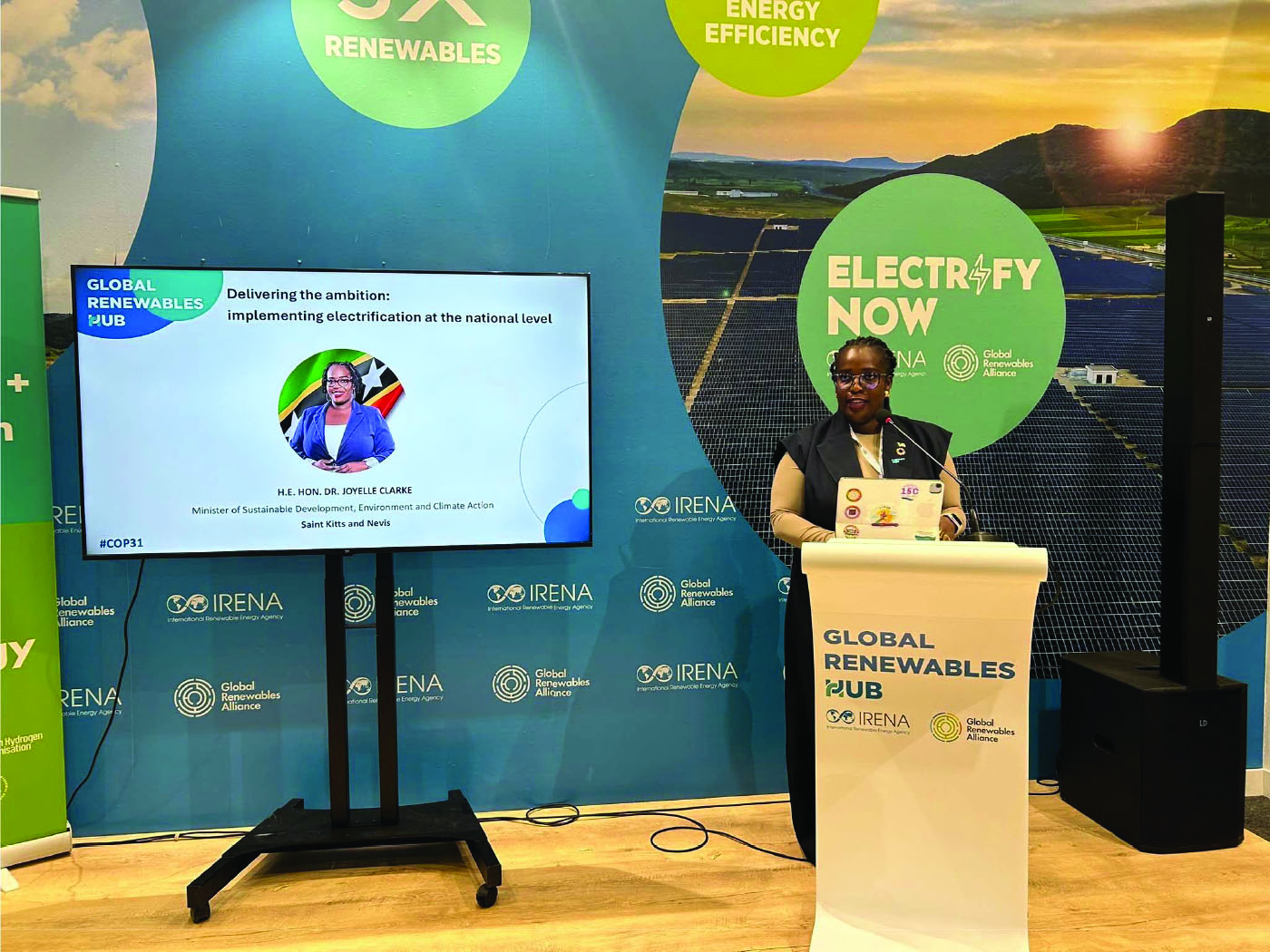
ANTALYA, Türkiye (Thursday 12th November 2026)-Access to affordable climate financing remains a major obstacle for Small Island Developing States (SIDS), according to St. Kitts and Nevis’ Minister responsible for Environment and Climate Action, Dr. Joyelle Clarke.
Speaking at a high-level ministerial panel on Tuesday 10th November 2026 during the United Nations Climate Change Conference (COP31), Dr. Clarke identified access to financing as a critical factor in moving renewable energy projects from planning to implementation.
The panel, held at the Green Renewables Hub, focused on the topic ‘From Pledge to Plans: Electrifying the Transition.’
“For Small Island Developing States, the principal obstacle is often not a lack of vision or political commitment, but access to affordable, predictable and appropriately structured financing,” Dr. Clarke said.
She called for greater access to concessional financing, investment guarantees, technology transfer and international partnerships that take into account the vulnerabilities of small island economies.
“We therefore call for stronger partnerships, concessional financing, investment guarantees, technology transfer and mechanisms that recognize the particular vulnerabilities of small island economies,” she stated.
Dr. Clarke outlined two renewable energy initiatives being advanced in St. Kitts and Nevis: a proposed 50-megawatt solar energy project in St. Kitts and an initial 30-megawatt geothermal energy development on Nevis.
According to her, the solar project is intended to reduce dependence on imported fossil fuels and improve energy security, while the geothermal development is expected to provide a source of reliable renewable electricity.
She also referred to the possibility of expanding geothermal development beyond the Federation’s immediate electricity requirements.
“With appropriate financing, technological investment and responsible scaling, we envisage the potential for geothermal development reaching between 600 and 1,000 megawatts,” she said.
Dr. Clarke linked the proposed energy developments to the Federation’s Sustainable Island State Agenda, which includes plans for cleaner transportation, modern infrastructure, climate-smart industries and resilient communities.
“Our objective is not simply to generate renewable energy, but to use that energy to improve lives, lower costs and unlock opportunities for future generations,” she said.
The Minister also referred to the Federation’s updated Nationally Determined Contribution and long-term low-emission development planning as part of the policy framework for its energy transition.
However, she pointed to the need for investment-ready projects, appropriate regulatory frameworks, energy storage, grid modernisation and implementation partnerships.
“Ambition alone does not build power plants, modernize grids or finance infrastructure,” Dr. Clarke stated.
She further addressed the role of climate financing in supporting national development.
“Our solar and geothermal ambitions demonstrate the opportunities that exist when climate finance is treated not merely as assistance, but as an investment in sustainable development,” she said.
In her closing remarks, Dr. Clarke again pointed to the financing and partnerships required to advance the Federation’s proposed energy developments.
“The pledge has been made. The potential is enormous. What we need now are the partnerships and financing to turn these plans into lasting prosperity for our people,” she stated.
COP31 is being held in Antalya, Türkiye, from 9th to 20th November 2026.