




A Black History Month Early Present: Buckley’s Uprising to Be Taught in Schools
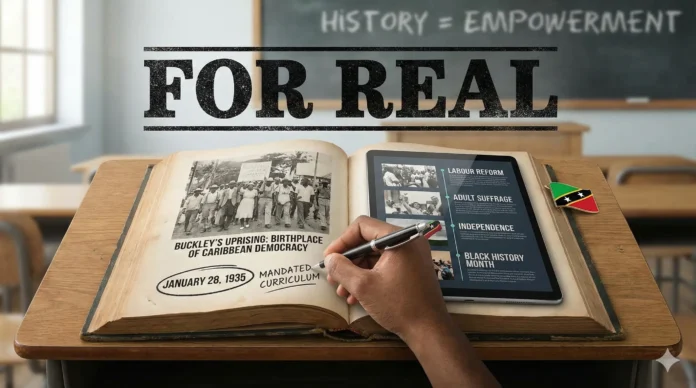
The best kind of news ahead of the start of Black History Month is the Government’s recent disclosure about approval for the 1935 Buckley’s Uprising to be mandated as part of the national history curriculum of all schools.
For far too many decades, St. Kitts and Nevis has missed critical opportunities to fully spotlight and institutionalise the teaching of an event that earned Buckley’s Estate the distinction of being recognised as the “Birthplace of Caribbean Democracy.” This was not a local disturbance confined to a sugar estate where workers stood up for justice; it was a seismic moment that ignited political awakening, labour reform, and democratic consciousness across the Caribbean and beyond-AN UPRISING!
Some of these workers on St.Kitts paid the ultimate sacrifice in the fight for betterment. Joseph Samuel, John Allen and James Archibald were killed, and others injured.
Further strengthening this week’s announcement moment-on the 91st anniversary occasion- include the acquisition of land for the establishment of a national monument at Buckley’s, progress from commitments made last year, Cabinet’s approval of the process for consideration of January 28 as a national holiday- a move that signals growing recognition of the uprising’s national importance as well as a commemorative button design competition for primary schools (grades 4-6) by the Buckley’s Uprising Committee.
So while many may rightly ask why it has taken so long, the reality remains: better late than never. Commendation is due to the Government for this important and forward-thinking decision. Equal recognition must also be given to the Rastafari movement-particularly the Nyabinghi Theocracy Order-for consistently keeping national attention focused on the significance of Buckley’s Uprising, ensuring that its meaning was neither diluted nor forgotten.
Once this history is formally embedded in the curriculum, generations present and those yet unborn will come to know what truly occurred and more importantly, understand the impact of a moment when disgruntled workers courageously rose to demand better wages, improved working conditions, and socio-economic advancement. Buckley’s Uprising was a pivotal chapter in our national story-one that opened avenues for profound transformation.
From that single moment flowed critical developments that shaped our Federation: adult suffrage (the right to vote), the legalisation of workers’ unions with the emergence of organised labour movements such as the St. Kitts-Nevis Trades and Labour Union, the formation of political parties and eventually the road toward independence. These were not coincidences; they were the direct outcomes of collective resistance and sacrifice.
Nor was the influence of Buckley’s Uprising confined to our shores. Other Caribbean territories drew inspiration from the courage displayed in 1935, adopting similar strategies in their own struggles for workers’ rights, self-governance, and political reform. Teaching this history properly places St. Kitts and Nevis in its rightful position as a catalyst for regional democratic development.
One cannot help but ask: What impact will this education have on our national psyche? What level of patriotism, civic consciousness, and pride will be ignited when young people understand that democracy here was not gifted but fought for? Knowing our past has the power to inform how we chart our future.
Indeed, we must learn to value our history if we are to empower ourselves.
It must be acknowledged that many citizens still do not fully understand the details or depth of the Buckley’s Uprising. Some only learn fragments of its history well into adulthood, while others remain unclear about its fundamental causes and consequences. This gap in knowledge underscores why the current announcement is not merely symbolic-it is essential.
Let this moment challenge all of us to learn, reflect and engage more deeply with our history, so that by the time 2027 arrives, January 28 will not be viewed as just another day off, but as a solemn and meaningful commemoration of sacrifice, struggle, and progress.
To truly honour Buckley’s Uprising, we must not only mark it on the calendar-we must emotionally, intellectually, and educationally comprehend its significance. Those who understand the history welcome this announcement precisely because they recognise its power to strengthen national identity and deepen democratic values.
This decision, coming at the threshold of Black History Month, is indeed an early present-one that, if properly implemented, will resonate for generations to come.